
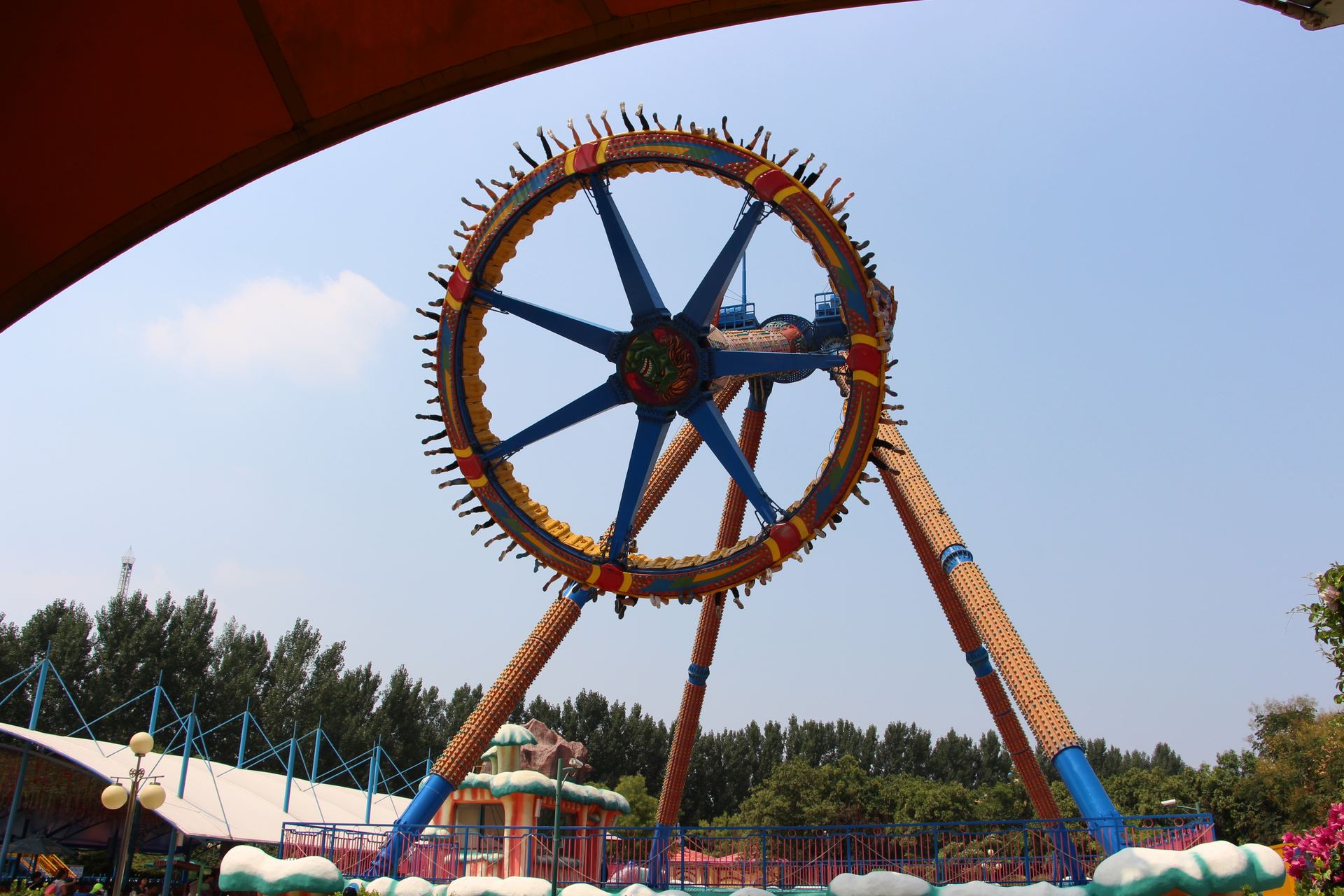
How pendulum rides work, in detail
Pendulum Ride for Sale
When you step into a giant pendulum ride at a theme park, your heart starts racing before the ride even begins. As the massive arm swings back and forth, carrying dozens of riders higher and higher, you can’t help but wonder: What makes this thrilling motion possible? The answer lies in physics—the science of motion, forces, and energy.
Pendulum rides, also known as giant swings or frisbee rides, are some of the most popular attractions in amusement parks around the world. They combine the exhilarating swing of a pendulum with the twisting, rotating, and sometimes even inverted motion of modern ride engineering. But beneath the screams of excitement and the colorful lights, every pendulum ride is a carefully engineered machine built on scientific principles.
We’ll dive deep into the physics behind pendulum rides, covering everything from gravity and inertia to centripetal force and energy conservation. By the end, you’ll have a clear understanding of why these rides feel so thrilling—and how engineers make them safe and reliable.
What Are Pendulum Rides Called Around the World?
Depending on where you are, pendulum rides might go by a variety of colorful names. While “pendulum ride” is the most straightforward term and commonly used within the industry, you’ll hear plenty of other names as you make your way from one theme park to another.
Some of the most popular alternatives include:
- Swing Ride: While technically a broader term that also covers chair swings, some parks use “swing ride” to describe these massive, back-and-forth attractions.
- Frisbee: Pay attention to the spinning action at the base of the ride—if it resembles a flying disc, you might spot the sign “Frisbee” above the entrance, especially in European parks.
- Gyro Swing: For rides that combine swinging with a 360-degree spinning gondola, “gyro swing” is a common label. Intamin’s Gyro Swing, found in parks like Lotte World in South Korea, is a famous example.
- Giant Swing: When the ride reaches super-sized proportions, you’ll often see the descriptor “giant swing,” highlighting its sheer scale.
No matter what the sign says in your local language, the heart-pounding motion is unmistakable—and the underlying physics remains the same.
What Is a Pendulum Ride?
A pendulum ride is a type of amusement attraction designed to swing riders back and forth in a wide arc, much like the motion of a traditional pendulum. Many pendulum rides also feature a spinning gondola at the bottom, adding another layer of excitement.
Some well-known types of pendulum rides include:
- Classic Pirate Ship Rides – These swing like a giant boat, often without inversion.
- Frisbee Rides – Featuring a rotating circular platform with outward-facing seats.
- Giant Swing Pendulums – Towering structures capable of reaching beyond 100 feet in the air.
- 360° Pendulum Rides – The most extreme version, completing full vertical loops.
Although their appearances differ, they all rely on the same underlying physics principles.
The Basic Physics of a Pendulum
At its core, a pendulum is simply an object suspended from a pivot, swinging back and forth under the influence of gravity.
Key Factors in Pendulum Motion
- Gravity – The restoring force that pulls the pendulum back toward its resting point.
- Inertia – The natural resistance of the object to changes in motion.
- Amplitude – The maximum distance the pendulum swings from its central position.
- Period – The time it takes for the pendulum to complete one full swing.
In amusement rides, these principles are scaled up dramatically. Instead of a simple weight, the pendulum carries dozens of riders, and instead of a rope, engineers use strong steel arms, hydraulic motors, and advanced bearings.
Gravity: The Driving Force
Gravity is the most essential force in pendulum rides. When the ride starts, motors or pneumatic systems pull the arm upward, giving it potential energy. Once released, gravity takes over, pulling the pendulum downward and converting that stored energy into motion.
As the pendulum descends, riders experience a sudden rush of acceleration. When it swings upward on the other side, gravity slows it down again. This repeating cycle is what creates the familiar back-and-forth swinging motion.
Energy Transformation on Pendulum Rides
Pendulum rides are fascinating examples of energy conservation at work.
- At the highest point, the ride has maximum potential energy (due to height).
- As it swings downward, this energy converts into kinetic energy (motion).
- At the bottom of the swing, kinetic energy is at its peak.
- As it rises again, kinetic energy turns back into potential energy.
This continuous transformation of energy is why the ride feels so thrilling—because riders constantly shift between slow, weightless moments and intense, high-speed plunges.
Centripetal Force: Why You Don’t Fall Out
One of the most exciting parts of a pendulum ride is when the gondola swings near its lowest point. Riders feel a strong push against their seats, almost as if they are being pressed downward. This sensation is caused by centripetal force —the inward force required to keep an object moving in a curved path.
- At the bottom of the swing, riders are moving the fastest.
- The pendulum arm changes the direction of motion from downward to upward.
- To accomplish this, centripetal force pushes riders into their seats.
This is also why safety harnesses and restraints are so crucial. Without them, inertia would cause riders to continue in a straight line instead of following the arc of the swing.
The Role of Inertia
Inertia is the tendency of an object to resist changes in motion. When the pendulum moves, your body wants to keep moving in a straight line. However, the seat and safety restraints force you to follow the curved path of the ride.
This tug-of-war between your body’s inertia and the ride’s motion is what produces the stomach-flipping sensations thrill-seekers love.
Angular Momentum and Rotation
Many pendulum rides include a rotating gondola. This adds another dimension of excitement by combining swinging with spinning. The rotation involves a concept called angular momentum, which is the momentum of a rotating object.
Because angular momentum is conserved, the spinning motion continues smoothly unless acted upon by friction or braking systems. The combination of swinging and spinning creates unpredictable forces, making each ride experience feel unique.
Why Pendulum Rides Feel Weightless
One of the most exciting sensations on a pendulum ride is the feeling of weightlessness. This occurs when the only force acting on you is gravity, with no additional support from the seat.
- At the very top of the swing, riders may experience a brief moment of near-weightlessness.
- On some 360° pendulum rides, when the gondola goes completely upside down, this sensation lasts even longer.
This weightless experience is similar to what astronauts feel in orbit, though on a much smaller scale.
The Mathematics Behind the Thrills
Pendulum rides are carefully designed using mathematical formulas to ensure both safety and excitement. Engineers calculate factors such as:
- Maximum height of the swing
- Period of oscillation
- Forces experienced by riders (measured in G-forces)
- Structural stress on the ride components
For example, the period of a simple pendulum can be calculated with the formula: T=2πLgT = 2\pi \sqrt{\frac{L}{g}}T=2πgL
- TTT = period (time for one swing)
- LLL = length of the pendulum arm
- ggg = acceleration due to gravity
While real rides are more complex, this formula provides a foundation for their design.
Safety Through Physics
Pendulum rides might look intimidating, but they are engineered with incredible precision. Physics plays a crucial role in ensuring safety:
- Harness Design – Restraints are built to counteract inertia and centripetal force.
- Material Strength – Engineers use high-strength steel and reinforced parts to withstand extreme stress.
- Controlled Motion – Hydraulic systems and motors regulate acceleration and braking.
- Force Limits – Designers ensure G-forces stay within safe limits for the human body.
Every thrilling swing you enjoy is backed by rigorous safety testing and physics-based engineering.
The Importance of Expert Ride Operators
Behind every smooth and exhilarating pendulum ride is a team of highly trained operators. Their expertise is not just reassuring—it’s essential for the safety and enjoyment of every rider.
- Skilled operators are versed in strict safety protocols, ensuring every harness and restraint is secured before launch.
- In the rare event of technical hiccups or unexpected situations, their training enables them to respond quickly and calmly, minimizing risks and keeping everyone safe.
- Regular drills and certifications—often modeled after industry leaders such as Six Flags or Cedar Fair—prepare them for everything from routine operations to emergency procedures.
Ultimately, the professionalism of ride operators adds an extra layer of security, letting thrill-seekers focus on the fun while the experts keep a watchful eye on every detail.
The Importance of Real-Time Monitoring
An essential aspect of modern pendulum ride safety is the use of real-time monitoring systems. These electric watchdogs constantly keep tabs on key ride parameters such as speed, swing angle, and hydraulic pressure. If any readings stray outside of safe operating ranges, the system instantly activates safety measures—like initiating an automatic stop or engaging emergency brakes—to protect riders on the spot.
Think of these monitoring systems as the attentive lifeguards of the amusement park world. Paired with rigorous engineering standards from organizations like ASTM International, they add another layer of reassurance for every thrilling drop and dizzying swing, ensuring the ride experience remains as safe as it is exhilarating.
Daily Inspections and Ongoing Maintenance
When it comes to the safety of pendulum rides (or any thrill ride, really), daily inspections and regular maintenance are absolutely essential. Every morning before the gates open, trained technicians meticulously check every bolt, joint, harness, and hydraulic system on rides like the Giant Frisbee or the Zamperla Discovery. This isn’t just a box-ticking exercise—these checks are crucial for catching wear and tear, loose components, or anything out of the ordinary that could compromise rider safety.
Routine maintenance goes beyond these daily inspections. Detailed schedules, much like those followed at global theme parks like Six Flags or Universal Studios, ensure that parts are lubricated, tested, and replaced before they become a problem. These procedures, recommended by ride manufacturers and enforced by regulatory bodies, help maintain peak performance and minimize unexpected breakdowns.
Ultimately, daily inspections and regular maintenance are the backbone of ride safety. Every time you strap in, you can thank not only physics, but also the diligent crews working behind the scenes to keep thrills safe and reliable.
What International Safety Standards Apply to Pendulum Rides?
As much as pendulum rides rely on precise physics, their safety is grounded in robust international standards. Reputable amusement rides are required to meet regulations set forth by organizations such as ASTM International (formerly known as the American Society for Testing and Materials) and the European Committee for Standardization (EN standards).
- ASTM F2291 outlines global requirements for the design, manufacture, and operation of amusement rides and devices.
- EN 13814, the European standard, covers the safety of amusement rides and amusement devices, including design, construction, and operation.
- Many countries also have local safety codes, but top-tier manufacturers build to exceed these international benchmarks.
Before any ride opens to the public, it undergoes thorough inspections, certifications, and often third-party audits. This multilayered approach ensures that every thrilling swing meets strict global safety criteria—providing peace of mind along with the adrenaline rush.
Why Pendulum Rides Are So Thrilling
The excitement of pendulum rides comes from how our bodies perceive motion. Rapid shifts between high speeds, weightlessness, and strong forces create sensations that our brains interpret as both thrilling and slightly terrifying.
Psychologists explain that thrill rides give us a safe way to experience fear, which is why they remain popular across all ages. Pendulum rides, in particular, are effective because they combine multiple sensations:
- Speed at the bottom of the swing
- Height at the top
- Weightlessness during free-fall moments
- Unexpected forces when spinning is added
This perfect blend of physics and psychology is what makes pendulum rides timeless favorites.
The Top 10 Most Popular Pendulum Rides Worldwide
If you’re craving world-class thrills and want to experience the finest pendulum rides ever created, these ten attractions regularly top enthusiasts’ must-try lists—and for good reason. Each has its own claim to pendulum fame, whether it’s record-breaking speed, towering heights, or unique ride experiences that keep adrenaline junkies coming back for more.
Here are ten of the most celebrated pendulum rides across the globe:
- CraZanity at Six Flags Magic Mountain (California, USA): Often hailed as the world’s tallest pendulum ride, CraZanity’s dizzying swings take riders to incredible heights while spinning at breakneck speeds.
- Wonder Woman: Lasso of Truth at Six Flags Great Adventure (New Jersey, USA): This superhero-themed ride delivers jaw-dropping arcs and spins, creating a sensation of true weightlessness at the top of every swing.
- Delirium at Kings Island (Ohio, USA): As one of North America’s largest pendulum rides, Delirium is famous for its imposing structure and the extreme forces it unleashes.
- MaXair at Cedar Point (Ohio, USA): This iconic giant swing offers sweeping views of Lake Erie as riders soar through the air, experiencing intense G-forces at every turn.
- Talon at Fantasy Valley (Chongqing, China): Boasting both size and speed, Talon is a star attraction in Asia’s growing lineup of record-setting thrill rides.
- Giant Frisbee at Nagashima Spa Land (Nagoya, Japan): Renowned for its impressive height and powerful swings, this ride is a staple for Japan’s thrill-seekers.
- Spin Cycle at Silverwood Theme Park (Idaho, USA): This ride stands out with its daring 360-degree spins, giving every trip a new twist.
- Kamikaze at Wiener Prater (Vienna, Austria): A long-time European favorite, Kamikaze thrills with its dramatic swings and historical amusement park setting.
- Berserker at Liseberg (Gothenburg, Sweden): Set against the backdrop of one of Sweden’s most beloved parks, Berserker combines wild spins with breathtaking views.
- Claw at Dreamworld (Australia): Featuring a formidable arc and stomach-dropping moments, Claw is considered a must-ride down under.
Whether you’re a seasoned thrill-seeker or just want to witness physics in motion, these popular pendulum rides are bucket-list material for any amusement park fan.
Pendulum rides–More Than Just Thrilling Attractions
Pendulum rides are more than just thrilling attractions—they’re living demonstrations of physics. Every swing, every spin, and every stomach-flipping moment can be explained through gravity, inertia, centripetal force, and energy conservation.
By understanding the science behind pendulum rides, we can appreciate not only the excitement they bring but also the incredible engineering that makes them safe and reliable. Next time you climb aboard a giant swing or frisbee ride, you’ll know exactly why it feels so thrilling—and you might even enjoy it more.
Whether you’re an amusement park enthusiast or simply curious about how rides work, the physics of pendulum rides proves one thing: science can be just as exciting as the ride itself.


