
Manufacturer-direct large thrill rides · Zhengzhou, China +86 182 0399 3035 [email protected]
PENDULUM & FRISBEE

Pendulum rides for sale

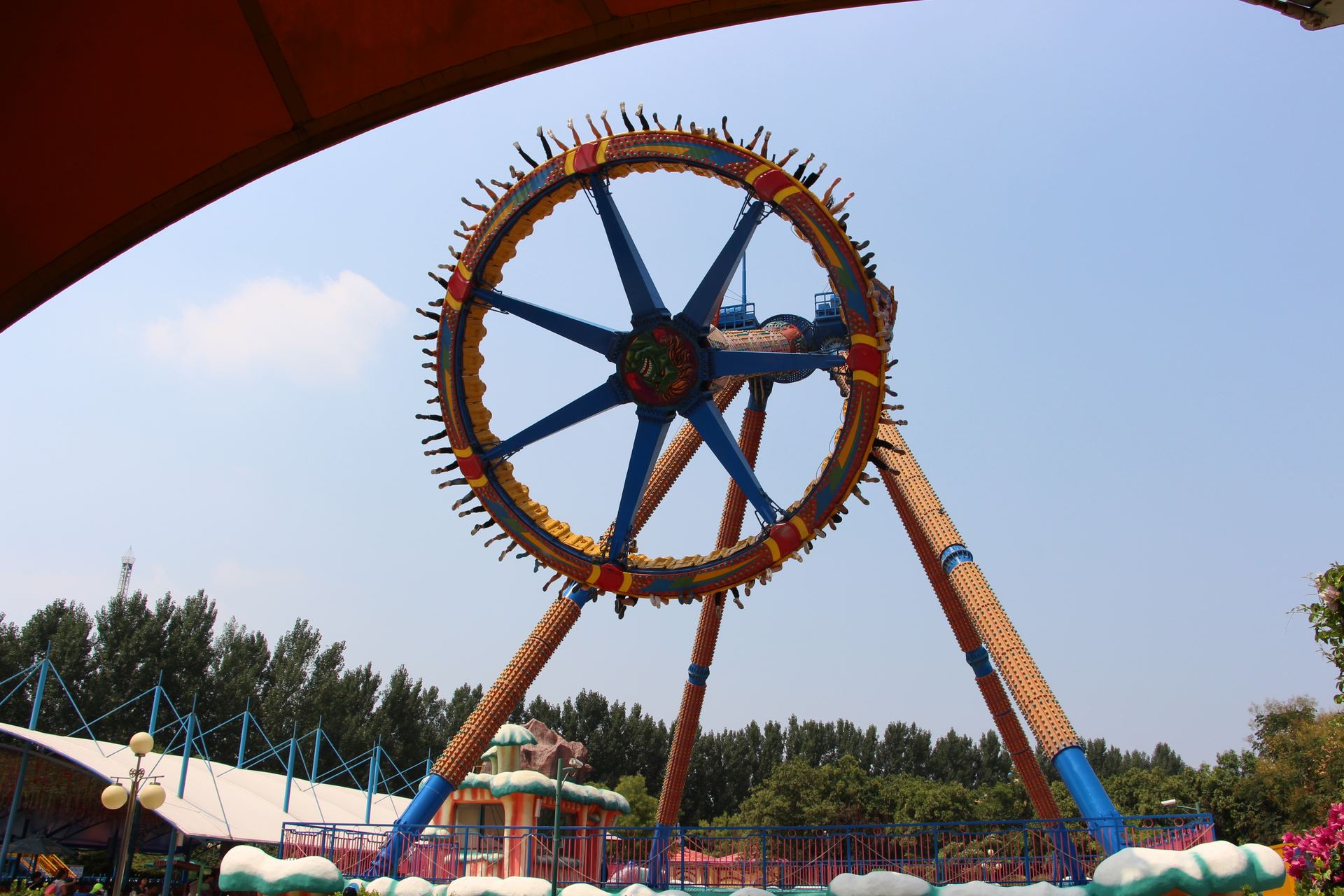
The pendulum ride is the tallest, most photographed machine in most parks — a gondola locked to a swinging arm, driven through 120° of travel and, on the 360° models, clean through inversion. We build four sizes so the ride can be matched to your clearance, not the other way round.

  • 23, 25, 30 and 42-seat pendulum rides plus a 24-seat frisbee
  • Swing angles of 43°, 120° and full 360° rotation depending on model
  • DC drive with PLC control, redundant braking and automatic restraint locking
  • Operating height, footprint and installed power published per model

Pendulum ride models at a glance

ModelSeatsSwing / rotationOperating heightInstalled powerFootprint
25-seat pendulum23–25120°≈15 m75 kW14 × 15 m
30-seat pendulum30120°≈18 m90 kW16 × 16 m
42-seat pendulum42120° / 360° option≈19–23 m110–140 kW20 × 18 m
Medium pendulum (12–24 seats)12–2443°–90°≈10.6 m23–71 kW11 × 10 m to 14 × 15 m
24-seat frisbee (space disc)24Rotating disc, 360°≈12 m55 kW14 × 14 m

Figures are for the standard configuration. Final values are confirmed on the drawing issued with your quotation.

What a pendulum ride actually does

A pendulum ride is built around a stiff steel arm that pivots on a horizontal axle. One end of the arm carries the passenger gondola; the other carries a counterweight or a second gondola. Rotating the axle swings the whole assembly through an arc, and the gondola adds its own rotation on top of the swing so riders are never quite sure which way is up.

Drive comes from DC motors acting on the axle, either directly or through tyre drives at the base of the station. Energy is stored in the pendulum as it falls, and released as it rises, which is why a relatively modest motor can carry a very large gondola: on our 42-seat model the installed load, including the rotating gondola drives, control system and lighting, is 110–140 kW.

The five pendulum configurations we build

Mini pendulum (6–12 seats)

The smallest format, usually rated to a 43° swing and 10.6 m of usable height. It fits indoors and is typically bought by family entertainment centres and shopping malls.

Medium pendulum (12–24 seats)

The sweet spot for outdoor family parks: a moderate 90° swing, 14 × 15 m of ground, and enough visual drama to be seen from the gate.

Frisbee / space disc (24 seats)

A large rotating disc gondola rather than a row of seats. The disc spins as the arm swings, producing two simultaneous motions at a lower structural height.

Growth pendulum (25–30 seats)

A 120° swing with a 15–18 m operating height for parks that have grown past their first ride and need a headline attraction.

360° pendulum (23–42 seats)

Full inversion. The gondola completes a rotation at the top of the arc, which means restraints, seat geometry and the counterweight design all become safety-critical. This is a flagship purchase.

How pendulum rides work, in detail

Pendulum Ride for Sale

When you step into a giant pendulum ride at a theme park, your heart starts racing before the ride even begins. As the massive arm swings back and forth, carrying dozens of riders higher and higher, you can’t help but wonder: What makes this thrilling motion possible? The answer lies in physics—the science of motion, forces, and energy.

Pendulum rides, also known as giant swings or frisbee rides, are some of the most popular attractions in amusement parks around the world. They combine the exhilarating swing of a pendulum with the twisting, rotating, and sometimes even inverted motion of modern ride engineering. But beneath the screams of excitement and the colorful lights, every pendulum ride is a carefully engineered machine built on scientific principles.

We’ll dive deep into the physics behind pendulum rides, covering everything from gravity and inertia to centripetal force and energy conservation. By the end, you’ll have a clear understanding of why these rides feel so thrilling—and how engineers make them safe and reliable.

What Are Pendulum Rides Called Around the World?

Depending on where you are, pendulum rides might go by a variety of colorful names. While “pendulum ride” is the most straightforward term and commonly used within the industry, you’ll hear plenty of other names as you make your way from one theme park to another.

Some of the most popular alternatives include:

  • Swing Ride: While technically a broader term that also covers chair swings, some parks use “swing ride” to describe these massive, back-and-forth attractions.
  • Frisbee: Pay attention to the spinning action at the base of the ride—if it resembles a flying disc, you might spot the sign “Frisbee” above the entrance, especially in European parks.
  • Gyro Swing: For rides that combine swinging with a 360-degree spinning gondola, “gyro swing” is a common label. Intamin’s Gyro Swing, found in parks like Lotte World in South Korea, is a famous example.
  • Giant Swing: When the ride reaches super-sized proportions, you’ll often see the descriptor “giant swing,” highlighting its sheer scale.

No matter what the sign says in your local language, the heart-pounding motion is unmistakable—and the underlying physics remains the same.

What Is a Pendulum Ride?

A pendulum ride is a type of amusement attraction designed to swing riders back and forth in a wide arc, much like the motion of a traditional pendulum. Many pendulum rides also feature a spinning gondola at the bottom, adding another layer of excitement.

Some well-known types of pendulum rides include:

  • Classic Pirate Ship Rides – These swing like a giant boat, often without inversion.
  • Frisbee Rides – Featuring a rotating circular platform with outward-facing seats.
  • Giant Swing Pendulums – Towering structures capable of reaching beyond 100 feet in the air.
  • 360° Pendulum Rides – The most extreme version, completing full vertical loops.

Although their appearances differ, they all rely on the same underlying physics principles.

The Basic Physics of a Pendulum

At its core, a pendulum is simply an object suspended from a pivot, swinging back and forth under the influence of gravity.

Key Factors in Pendulum Motion

  1. Gravity – The restoring force that pulls the pendulum back toward its resting point.
  2. Inertia – The natural resistance of the object to changes in motion.
  3. Amplitude – The maximum distance the pendulum swings from its central position.
  4. Period – The time it takes for the pendulum to complete one full swing.

In amusement rides, these principles are scaled up dramatically. Instead of a simple weight, the pendulum carries dozens of riders, and instead of a rope, engineers use strong steel arms, hydraulic motors, and advanced bearings.

Gravity: The Driving Force

Gravity is the most essential force in pendulum rides. When the ride starts, motors or pneumatic systems pull the arm upward, giving it potential energy. Once released, gravity takes over, pulling the pendulum downward and converting that stored energy into motion.

As the pendulum descends, riders experience a sudden rush of acceleration. When it swings upward on the other side, gravity slows it down again. This repeating cycle is what creates the familiar back-and-forth swinging motion.

Energy Transformation on Pendulum Rides

Pendulum rides are fascinating examples of energy conservation at work.

  • At the highest point, the ride has maximum potential energy (due to height).
  • As it swings downward, this energy converts into kinetic energy (motion).
  • At the bottom of the swing, kinetic energy is at its peak.
  • As it rises again, kinetic energy turns back into potential energy.

This continuous transformation of energy is why the ride feels so thrilling—because riders constantly shift between slow, weightless moments and intense, high-speed plunges.

Centripetal Force: Why You Don’t Fall Out

One of the most exciting parts of a pendulum ride is when the gondola swings near its lowest point. Riders feel a strong push against their seats, almost as if they are being pressed downward. This sensation is caused by centripetal force —the inward force required to keep an object moving in a curved path.

  • At the bottom of the swing, riders are moving the fastest.
  • The pendulum arm changes the direction of motion from downward to upward.
  • To accomplish this, centripetal force pushes riders into their seats.

This is also why safety harnesses and restraints are so crucial. Without them, inertia would cause riders to continue in a straight line instead of following the arc of the swing.

The Role of Inertia

Inertia is the tendency of an object to resist changes in motion. When the pendulum moves, your body wants to keep moving in a straight line. However, the seat and safety restraints force you to follow the curved path of the ride.

This tug-of-war between your body’s inertia and the ride’s motion is what produces the stomach-flipping sensations thrill-seekers love.

Angular Momentum and Rotation

Many pendulum rides include a rotating gondola. This adds another dimension of excitement by combining swinging with spinning. The rotation involves a concept called angular momentum, which is the momentum of a rotating object.

Because angular momentum is conserved, the spinning motion continues smoothly unless acted upon by friction or braking systems. The combination of swinging and spinning creates unpredictable forces, making each ride experience feel unique.

Why Pendulum Rides Feel Weightless

One of the most exciting sensations on a pendulum ride is the feeling of weightlessness. This occurs when the only force acting on you is gravity, with no additional support from the seat.

  • At the very top of the swing, riders may experience a brief moment of near-weightlessness.
  • On some 360° pendulum rides, when the gondola goes completely upside down, this sensation lasts even longer.

This weightless experience is similar to what astronauts feel in orbit, though on a much smaller scale.

The Mathematics Behind the Thrills

Pendulum rides are carefully designed using mathematical formulas to ensure both safety and excitement. Engineers calculate factors such as:

  • Maximum height of the swing
  • Period of oscillation
  • Forces experienced by riders (measured in G-forces)
  • Structural stress on the ride components

For example, the period of a simple pendulum can be calculated with the formula: T=2πLgT = 2\pi \sqrt{\frac{L}{g}}T=2πgL

  • TTT = period (time for one swing)
  • LLL = length of the pendulum arm
  • ggg = acceleration due to gravity

While real rides are more complex, this formula provides a foundation for their design.

Safety Through Physics

Pendulum rides might look intimidating, but they are engineered with incredible precision. Physics plays a crucial role in ensuring safety:

  • Harness Design – Restraints are built to counteract inertia and centripetal force.
  • Material Strength – Engineers use high-strength steel and reinforced parts to withstand extreme stress.
  • Controlled Motion – Hydraulic systems and motors regulate acceleration and braking.
  • Force Limits – Designers ensure G-forces stay within safe limits for the human body.

Every thrilling swing you enjoy is backed by rigorous safety testing and physics-based engineering.

The Importance of Expert Ride Operators

Behind every smooth and exhilarating pendulum ride is a team of highly trained operators. Their expertise is not just reassuring—it’s essential for the safety and enjoyment of every rider.

  • Skilled operators are versed in strict safety protocols, ensuring every harness and restraint is secured before launch.
  • In the rare event of technical hiccups or unexpected situations, their training enables them to respond quickly and calmly, minimizing risks and keeping everyone safe.
  • Regular drills and certifications—often modeled after industry leaders such as Six Flags or Cedar Fair—prepare them for everything from routine operations to emergency procedures.

Ultimately, the professionalism of ride operators adds an extra layer of security, letting thrill-seekers focus on the fun while the experts keep a watchful eye on every detail.

The Importance of Real-Time Monitoring

An essential aspect of modern pendulum ride safety is the use of real-time monitoring systems. These electric watchdogs constantly keep tabs on key ride parameters such as speed, swing angle, and hydraulic pressure. If any readings stray outside of safe operating ranges, the system instantly activates safety measures—like initiating an automatic stop or engaging emergency brakes—to protect riders on the spot.

Think of these monitoring systems as the attentive lifeguards of the amusement park world. Paired with rigorous engineering standards from organizations like ASTM International, they add another layer of reassurance for every thrilling drop and dizzying swing, ensuring the ride experience remains as safe as it is exhilarating.

Daily Inspections and Ongoing Maintenance

When it comes to the safety of pendulum rides (or any thrill ride, really), daily inspections and regular maintenance are absolutely essential. Every morning before the gates open, trained technicians meticulously check every bolt, joint, harness, and hydraulic system on rides like the Giant Frisbee or the Zamperla Discovery. This isn’t just a box-ticking exercise—these checks are crucial for catching wear and tear, loose components, or anything out of the ordinary that could compromise rider safety.

Routine maintenance goes beyond these daily inspections. Detailed schedules, much like those followed at global theme parks like Six Flags or Universal Studios, ensure that parts are lubricated, tested, and replaced before they become a problem. These procedures, recommended by ride manufacturers and enforced by regulatory bodies, help maintain peak performance and minimize unexpected breakdowns.

Ultimately, daily inspections and regular maintenance are the backbone of ride safety. Every time you strap in, you can thank not only physics, but also the diligent crews working behind the scenes to keep thrills safe and reliable.

What International Safety Standards Apply to Pendulum Rides?

As much as pendulum rides rely on precise physics, their safety is grounded in robust international standards. Reputable amusement rides are required to meet regulations set forth by organizations such as ASTM International (formerly known as the American Society for Testing and Materials) and the European Committee for Standardization (EN standards).

  • ASTM F2291 outlines global requirements for the design, manufacture, and operation of amusement rides and devices.
  • EN 13814, the European standard, covers the safety of amusement rides and amusement devices, including design, construction, and operation.
  • Many countries also have local safety codes, but top-tier manufacturers build to exceed these international benchmarks.

Before any ride opens to the public, it undergoes thorough inspections, certifications, and often third-party audits. This multilayered approach ensures that every thrilling swing meets strict global safety criteria—providing peace of mind along with the adrenaline rush.

Why Pendulum Rides Are So Thrilling

The excitement of pendulum rides comes from how our bodies perceive motion. Rapid shifts between high speeds, weightlessness, and strong forces create sensations that our brains interpret as both thrilling and slightly terrifying.

Psychologists explain that thrill rides give us a safe way to experience fear, which is why they remain popular across all ages. Pendulum rides, in particular, are effective because they combine multiple sensations:

  • Speed at the bottom of the swing
  • Height at the top
  • Weightlessness during free-fall moments
  • Unexpected forces when spinning is added

This perfect blend of physics and psychology is what makes pendulum rides timeless favorites.

The Top 10 Most Popular Pendulum Rides Worldwide

If you’re craving world-class thrills and want to experience the finest pendulum rides ever created, these ten attractions regularly top enthusiasts’ must-try lists—and for good reason. Each has its own claim to pendulum fame, whether it’s record-breaking speed, towering heights, or unique ride experiences that keep adrenaline junkies coming back for more.

Here are ten of the most celebrated pendulum rides across the globe:

  • CraZanity at Six Flags Magic Mountain (California, USA): Often hailed as the world’s tallest pendulum ride, CraZanity’s dizzying swings take riders to incredible heights while spinning at breakneck speeds.
  • Wonder Woman: Lasso of Truth at Six Flags Great Adventure (New Jersey, USA): This superhero-themed ride delivers jaw-dropping arcs and spins, creating a sensation of true weightlessness at the top of every swing.
  • Delirium at Kings Island (Ohio, USA): As one of North America’s largest pendulum rides, Delirium is famous for its imposing structure and the extreme forces it unleashes.
  • MaXair at Cedar Point (Ohio, USA): This iconic giant swing offers sweeping views of Lake Erie as riders soar through the air, experiencing intense G-forces at every turn.
  • Talon at Fantasy Valley (Chongqing, China): Boasting both size and speed, Talon is a star attraction in Asia’s growing lineup of record-setting thrill rides.
  • Giant Frisbee at Nagashima Spa Land (Nagoya, Japan): Renowned for its impressive height and powerful swings, this ride is a staple for Japan’s thrill-seekers.
  • Spin Cycle at Silverwood Theme Park (Idaho, USA): This ride stands out with its daring 360-degree spins, giving every trip a new twist.
  • Kamikaze at Wiener Prater (Vienna, Austria): A long-time European favorite, Kamikaze thrills with its dramatic swings and historical amusement park setting.
  • Berserker at Liseberg (Gothenburg, Sweden): Set against the backdrop of one of Sweden’s most beloved parks, Berserker combines wild spins with breathtaking views.
  • Claw at Dreamworld (Australia): Featuring a formidable arc and stomach-dropping moments, Claw is considered a must-ride down under.

Whether you’re a seasoned thrill-seeker or just want to witness physics in motion, these popular pendulum rides are bucket-list material for any amusement park fan.

Pendulum rides–More Than Just Thrilling Attractions

Pendulum rides are more than just thrilling attractions—they’re living demonstrations of physics. Every swing, every spin, and every stomach-flipping moment can be explained through gravity, inertia, centripetal force, and energy conservation.

By understanding the science behind pendulum rides, we can appreciate not only the excitement they bring but also the incredible engineering that makes them safe and reliable. Next time you climb aboard a giant swing or frisbee ride, you’ll know exactly why it feels so thrilling—and you might even enjoy it more.

Whether you’re an amusement park enthusiast or simply curious about how rides work, the physics of pendulum rides proves one thing: science can be just as exciting as the ride itself.

Is a pendulum ride safe?

About Pendulum Rides

What Is a Frisbee (Pendulum) Ride?

A frisbee ride—commonly referred to as a pendulum ride in the amusement park world—is all about high-flying excitement. Picture this: a giant circular platform with seats, securely fastened to a colossal swinging arm. As the ride begins, the arm sets the whole contraption into a broad swinging motion while the circular gondola spins.

The result? Riders experience an exhilarating mix of swooping back-and-forth pendulum swings and heart-pounding rotations, creating thrilling sensations of weightlessness. Depending on the ride’s design, swings can range from a gentler arc to wild 360-degree revolutions. Popular versions of these rides can be found everywhere from Six Flags parks to local carnivals, earning nicknames like “Frisbee,” “Giant Swing,” or even “Pendulum Hammer” from ride enthusiasts.

Pendulum rides are amusement rides based on the motion of a fixed pendulum. The ride configuration consists of a gondola, an arm, and an axle. One end of the arm is fitted with a passenger-carrying gondola, while the other is attached to the axle. Are pendulum rides safe? Pendulum rides are safe in amusement parks. They offer exhilarating experiences that combine swinging motions with varying degrees of rotation. While they are designed with safety in mind, understanding their safety aspects is crucial for both operators and riders.

Pendulum rides are generally safe when they are manufactured, maintained, and operated according to established safety standards. Reputable manufacturers construct these rides using high-quality materials and incorporate multiple safety features to ensure rider protection.

What Components Are Used to Manufacture Frisbee Rides?

Frisbee rides, a popular type of pendulum attraction, rely on a carefully engineered mix of mechanical and electrical parts to ensure both thrill and safety. The quality of these components is essential in providing that signature swinging motion for riders—all while keeping everything running smoothly.

First up are the mechanical elements, which act as the ride’s backbone:

  • Pneumatic cylinders and motors work together to initiate and control the swinging movement.
  • Bearings—such as slewing and deep groove bearings—ensure that both the rotating and pivoting motions are smooth and stable.
  • Parts like flanges, planetary reducers, torsion couplings, and even specially designed support arms (“chicken leg shoulders” in ride lingo) contribute to strength, precision, and durability.
  • Additional fixtures such as air compressors and threaded assemblies keep all major components tightly integrated.

On the electrical side, safety and smooth operation are the priorities:

  • Power distribution panels, circuit breakers, and switching supplies deliver reliable electrical power throughout the system.
  • Control features like emergency stop switches, relays, rotary switches, and programmable logic controllers (PLCs) give operators precise control over every ride cycle.
  • Monitoring devices, including ammeters, voltmeters, frequency converters, and indicator lights, help staff keep a close watch on essential ride functions.
  • Communication connectors, terminal blocks, and safety components such as resistance elements round out the lineup, ensuring every ride is as secure as it is exciting.

Together, this blend of mechanical precision and electrical control allows frisbee rides to deliver the exhilarating pendulum experience visitors love—while meeting the rigorous demands of amusement park safety.

How Frisbee Rides Are Tested and Validated

Before welcoming passengers on board, frisbee rides are put through a comprehensive series of tests to ensure they meet strict safety and quality standards. These evaluations typically include:

  • No-Load Tests: The ride is operated without any passengers, allowing engineers to monitor critical systems and observe the mechanics in action. This helps detect irregularities in movement, sound, and safety mechanisms.
  • Load Tests: Weighted dummies or ballast simulate the maximum potential passenger load, verifying that the structure and safety features perform reliably under real-world conditions.
  • Extended Operation: These tests aren’t short sprints. The rides often undergo continuous testing over several days—sometimes for up to eighty hours in total—to mimic the stresses of daily park operation.

Through these rigorous procedures, engineers can confirm that every component—from swinging arms to safety restraints—works seamlessly, setting the stage for a safe and thrilling experience for all riders.

Quality Certifications for Frisbee Rides

When it comes to frisbee rides, safety and reliability start with proper certifications. Reputable manufacturers typically obtain internationally recognized certifications such as CE (Conformité Européenne), BV (Bureau Veritas), and TUV (Technischer Überwachungsverein). These certifications indicate that the rides have undergone rigorous testing and comply with stringent safety and quality standards set by leading regulatory bodies in the amusement industry.

Choosing a frisbee ride with these certifications helps ensure a higher level of trust and peace of mind for both operators and riders.

What Steps Are Involved in Assembling a Frisbee Ride?

Constructing a frisbee ride is a meticulous process that brings together both artistry and engineering. The assembly unfolds through several key stages:

  • Shaping the Components: Skilled technicians begin by crafting the major components. Seats and the gondola bodies are often molded from fiber-reinforced fiberglass, offering both strength and a polished finish that resists wear from weather and riders alike.
  • Building the Framework: Next, high-grade steel is precision cut, welded, and machined—frequently using advanced CNC equipment. This process shapes the arm, main support structure, and all critical connecting parts, ensuring stability and resilience for years of operation.
  • Comprehensive Assembly: Once the main parts are ready, specialists bring together the steel framework, gondola, and moving elements. Electrical systems and state-of-the-art safety controls—modeled on industry leaders like Zamperla or Intamin—are carefully integrated to govern motion and keep everything running smoothly.
  • Finishing Touches: Protective coatings and vibrant paints are applied, creating the colorful, eye-catching appearance these rides are known for and further shielding the structure from the elements.

These rigorous assembly steps, when paired with strict quality controls and worldwide safety standards, ensure that frisbee rides are built both to thrill and to last.

Production Phase: How Frisbee Rides Are Made

The journey from blueprint to thrill ride involves several meticulously managed steps designed to ensure both fun and safety. Here’s a look at what goes into bringing a frisbee ride to life:

  • Fiberglass Crafting: Durable, fiber-reinforced fiberglass is precisely shaped into seats, gondola shells, and the main body panels. These lightweight but sturdy elements form the passenger areas and defining features of the ride.
  • Steel Structure Fabrication: Heavy-duty steel components are cut, welded, and machined with high precision. These critical pieces—including support arms and the central axle—form the backbone of the ride, providing strength and stability for years of operation.
  • Assembly and Integration: Next, all mechanical and electrical systems are carefully installed and tested. This includes joining the steel framework, attaching the gondola, and integrating the electronic control and safety systems that coordinate every movement and monitor ride performance.
  • Finishing Touches: Only after these key systems are in place does the team focus on painting and detailing. This not only delivers the iconic, eye-catching look but also adds layers of protection against the elements.

By focusing on quality materials and careful assembly, each step in the process brings the frisbee ride closer to safely spinning and swinging eager riders at amusement parks around the world.

How Fiber-Reinforced Fiberglass and Steel Components Are Made for Frisbee Rides

Pendulum rides, sometimes called frisbee rides, owe their strength and durability to the meticulous process used to create their major components. Two of the most critical materials at play are fiber-reinforced fiberglass and high-grade steel. Here’s a peek behind the curtain at how these essential elements come together:

  • Fiber-Reinforced Fiberglass Construction: To form parts like passenger seats, gondola shells, and protective panels, layers of fiberglass cloth are combined with a robust resin, then carefully molded into precise shapes and sizes. This layered structure provides exceptional strength without adding unnecessary weight, making it ideal for both comfort and safety. Once cured, the fiberglass is sanded and finished for a smooth and durable surface that can withstand years of thrills.
  • Steel Component Fabrication: The ride’s main arm, support structure, and mechanical assemblies rely on industrial-grade steel. The process begins with raw steel, which is cut to exact specifications. Precision tools—such as computer-controlled cutters, welders, and bending machines—shape each piece for a perfect fit. After welding and joining, every connection is carefully deburred to prevent rough edges, resulting in a sleek, resilient framework that stands up to the intense forces of the ride.

These manufacturing steps ensure that each frisbee ride is both sturdy and secure, setting the stage for a safe and exciting experience.

The Design Phase of a Frisbee Ride

Once high-quality materials are selected, the next critical step is designing the frisbee ride. The design phase lays the foundation for both ride performance and safety, influencing how the attraction will look, feel, and function.

During this stage, detailed schematics and engineering drawings bring the concept to life. Whether inspired by industry trends or custom client visions, these blueprints outline every aspect of the ride—from dimensions and seating arrangements to load calculations and motion mechanics.

Typically, clients work closely with manufacturers by providing sketches or specific requirements. These ideas are then transformed into comprehensive plans, with precise measurements and technical specifications. This stage, often referred to as design development, blends creativity with engineering rigor to ensure the ride will not only amaze guests, but also meet stringent safety standards.

With a solid design in place, manufacturers can move on to fabrication, using these detailed plans as a roadmap for building a pendulum ride that delights thrill seekers while adhering to strict safety regulations.

Main Steps in Manufacturing a Frisbee Ride

The creation of a frisbee ride—a close cousin to the classic pendulum ride—involves a series of carefully orchestrated steps to ensure both thrill and safety. Here’s a closer look at the manufacturing process:

  • Material Selection: Manufacturers begin by sourcing top-grade steel and other premium components to build a structure that can withstand years of dynamic motion and heavy use.
  • Engineering & Design: Skilled engineers use advanced software to draft detailed blueprints. This stage balances mechanical stability with the unique, exhilarating movement patterns that make frisbee rides popular attractions worldwide.
  • Assembly & Fabrication: With designs finalized, the ride takes shape in specialized fabrication workshops. Each major element—the arm, axle, gondola, and structural supports—is assembled to precise specifications.
  • Inspection & Testing: Before finding its home in an amusement park, the completed ride undergoes rigorous safety inspections and repeated testing. This includes running the ride under various loads and motion cycles to ensure everything performs reliably and safely.

Each of these steps is guided by international safety standards and often incorporates industry best practices, helping ensure that every frisbee ride delivers not just excitement but peace of mind for riders and operators alike.

How Are Frisbee Rides Manufactured?

Creating a frisbee ride is a meticulous process, blending advanced engineering with stringent safety measures. Let’s take a look behind the scenes at how these thrilling attractions are brought to life:

  • Precision Engineering and Cutting The journey begins with the careful selection of high-grade steel. Using laser-guided cutting technology—much like the processes seen in leading automotive plants—each component is shaped with remarkable accuracy. This ensures every piece fits together perfectly, minimizing the risk of structural flaws.
  • Derusting and Surface Preparation Once the steel is cut, it undergoes comprehensive derusting in a controlled, dust-free environment. This prep step is essential for both the smooth finish of the ride and its long-term durability.
  • Advanced Welding Techniques Skilled technicians then weld each component together with precision. These welds are subjected to strict inspections to ensure there are no weak points, supporting the robust structure necessary for rider safety.
  • Protective Painting and Coating To shield the ride from weather and wear, multiple layers of water-resistant and anti-rust paint are applied. This not only helps maintain the ride’s bright appearance but also extends its lifespan against the elements.
  • Multi-layered Safety Features for Seats The installation of seating comes next, each equipped with multi-point safety harnesses and padded restraints. These safeguards are comparable to those found on world-renowned attractions, ensuring riders are secure throughout the experience.

Every stage— from fabrication to assembly— adheres to strict international safety standards. By combining skilled craftsmanship with modern technology, manufacturers ensure frisbee rides provide exhilarating fun while prioritizing safety at every turn.

4 Key Safety Features

  1. Robust Construction: Pendulum rides are built with heavy-duty steel structures, ensuring durability and stability during operation. The selection of materials is a critical step in their manufacturing process. High-quality steel forms the backbone of the ride, providing the strength needed to withstand immense forces and repeated use. In addition to steel, fiber-reinforced fiberglass is often used for certain components, offering a combination of toughness and reduced weight. Together, these materials ensure that the ride maintains its integrity and safety, even under the demanding conditions of daily amusement park operations.
  2. Advanced Restraint Systems: Riders are secured using over-the-shoulder harnesses and seat belts, minimizing the risk of ejection during intense motions.
  3. Regular Inspections: Routine checks and maintenance are conducted to identify and rectify potential issues, ensuring the ride remains in optimal condition.
  4. Operator Training: Operators receive comprehensive training to handle the ride safely, manage emergencies, and ensure rider compliance with safety protocols.

Thorough Testing Procedures

Before welcoming any riders aboard, pendulum—or “frisbee”—rides go through extensive testing to ensure everything operates flawlessly. These procedures encompass both empty (no-load) and full (load) test cycles to simulate real-world conditions. Typically, this process spans up to 80 hours in total, often spread across several days.

This methodical approach allows engineers and inspectors to verify structural integrity, safety systems, and ride dynamics under varying conditions, mirroring industry best practices seen at major parks like Six Flags and Cedar Point. Only after passing all safety benchmarks does a frisbee ride make its public debut.

Installation of Safety and Electronic Control Systems

Once the primary mechanical and electrical components of a frisbee (pendulum) ride are assembled, attention turns to the crucial step of installing safety and electronic control systems. High-quality safety systems—such as failsafe restraint mechanisms and redundant emergency stop controls—are integrated directly into the ride’s structure. Carefully positioned sensors, automatic shutdown features, and real-time diagnostic systems work together to ensure rider safety and efficient operation.

The electronic control system, often featuring cutting-edge technology from industry leaders like Siemens or Schneider Electric, is configured to monitor and manage all ride functions. This includes speed regulation, restraint monitoring, and emergency responses. After these systems have been thoroughly installed, the ride undergoes finishing touches such as painting, followed by extensive testing to confirm that every safety and control element functions as intended.

Two Notable Incidents and Lessons Learned

While pendulum rides are designed for safety, incidents have occurred, often due to mechanical failures or lapses in maintenance:

  • Ohio State Fair (2017): A tragic accident occurred when a row of seats detached from the Fire Ball ride, resulting in one fatality and several injuries. Investigations highlighted the importance of thorough inspections and maintenance.
  • Kankaria Amusement Park, India (2019): The Discovery pendulum ride broke mid-air, leading to two deaths and multiple injuries. The incident underscored the necessity for stringent safety checks and adherence to manufacturing standards.

These incidents emphasize the critical need for regular maintenance, adherence to safety protocols, and prompt response to any identified issues.

Ensuring Safety by Best Practices

  • Purchase from Reputable Manufacturers: Ensure the ride is sourced from manufacturers with a proven safety record.
  • Adhere to Maintenance Schedules: Regularly inspect and maintain the ride as per the manufacturer’s guidelines.
  • Train Staff Thoroughly: Operators should be well-trained in both daily operations and emergency procedures.
  • Follow Instructions: Adhere to all safety guidelines provided by the ride operators.
  • Use Restraints Properly: Ensure all harnesses and seat belts are securely fastened.
  • Report Concerns: If any safety issues are noticed, inform the ride operators immediately.

Who Are The Suitable Users of Frisbee Rides

Pendulum rides designed for children operate at lower speeds and heights, providing a thrilling yet safe experience. These rides incorporate additional safety measures tailored for younger riders, ensuring their well-being during the ride.

Children’s pendulum rides are typically suitable for kids above a certain age and height—often recommended for those aged 5 and up, or at least 100 cm tall. Strict height and age restrictions are enforced to ensure that only children who can be safely secured with the provided restraints are allowed to board.

Parental Supervision and Guidelines

Parental supervision is crucial, especially for younger or first-time riders. Parents should review all posted guidelines, make sure children are comfortably fastened, and confirm that they meet the minimum height and health requirements. It’s important not to force a hesitant child to ride, as a willingness to participate also contributes to safety.

Children with certain medical conditions—such as heart issues, neck or back problems, or motion sickness—should avoid pendulum rides. Always consult ride operators if you have health-related concerns before allowing a child to ride.

By ensuring that children meet the age, height, and health recommendations, and by following all safety instructions, both parents and operators can help create a safe and enjoyable experience for young riders on pendulum rides.

What drives the cost of a pendulum ride

Seat count and gondola size

A 42-seat gondola is a much larger structural load than a 25-seat gondola, and drives the arm, axle and foundation sizing up with it.

Swing angle

Going from 90° to 120°, and again from 120° to a full 360° inversion, changes the restraint system, counterweight and fatigue verification work.

Theming depth

Plain hot-dip galvanised and painted steel costs far less than a fully themed gondola with sculpted fibreglass, LED matrix lighting and a soundtrack system.

Control and redundancy

Redundant braking, triple-redundant restraint locks, PLC safety circuits and emergency lowering all add cost, and all appear in our standard specification rather than as options.

Shipping route and crane plan

The arm and gondola are shipped as separate assemblies. Port choice, container versus flat rack, and crane capacity at your site all affect the delivered price.

Which pendulum fits your site?

Send us the plot size, the clearance above it and the supply voltage you have available. We will tell you the largest model you can install, and what the next size up would need.

  • Reply within one working day
  • Layout sketch and model recommendation included
  • No obligation, no sales calls

We use your details only to answer this enquiry. See our privacy policy.

Frequently asked questions

How tall does a pendulum ride need to be?

The medium pendulum needs about 10.6 m of structural height and a 14 × 15 m plot. A 120° 25–30 seat pendulum needs 15–18 m of operating height. The 42-seat 360° model reaches roughly 19–23 m at full swing, so allow clearance plus a safety margin above the highest point of the arc.

What power supply does a pendulum ride require?

Standard offerings are 380 V three-phase plus neutral and earth at 50 Hz, with installed loads from 23 kW on the smallest unit to 140 kW on a 42-seat 360° model. If your site runs on 60 Hz we build the drive package accordingly — tell us your supply at the enquiry stage.

How many riders per hour can a pendulum ride handle?

Cycle time on a 25-seat pendulum is roughly 180 seconds including loading, which gives about 400–480 riders per hour at realistic loading efficiency. Larger gondolas do not shorten the cycle, but they do raise the number of people moved per cycle.

Can a pendulum ride be installed indoors?

Mini and medium pendulums are commonly installed inside malls and entertainment centres, subject to ceiling height, floor loading and fire code. We derate the swing angle for indoor units and can specify quieter drives and enclosed cable runs.

What is the difference between a pendulum ride and a frisbee ride?

Mechanically they share the swinging arm. The difference is the gondola: a pendulum carries riders in a seated row facing outward, while a frisbee carries them on a rotating disc that spins as the arm swings. The frisbee gives two motions at a lower structure height; the pendulum gives a longer, cleaner arc.

Call WhatsApp Get a quote