
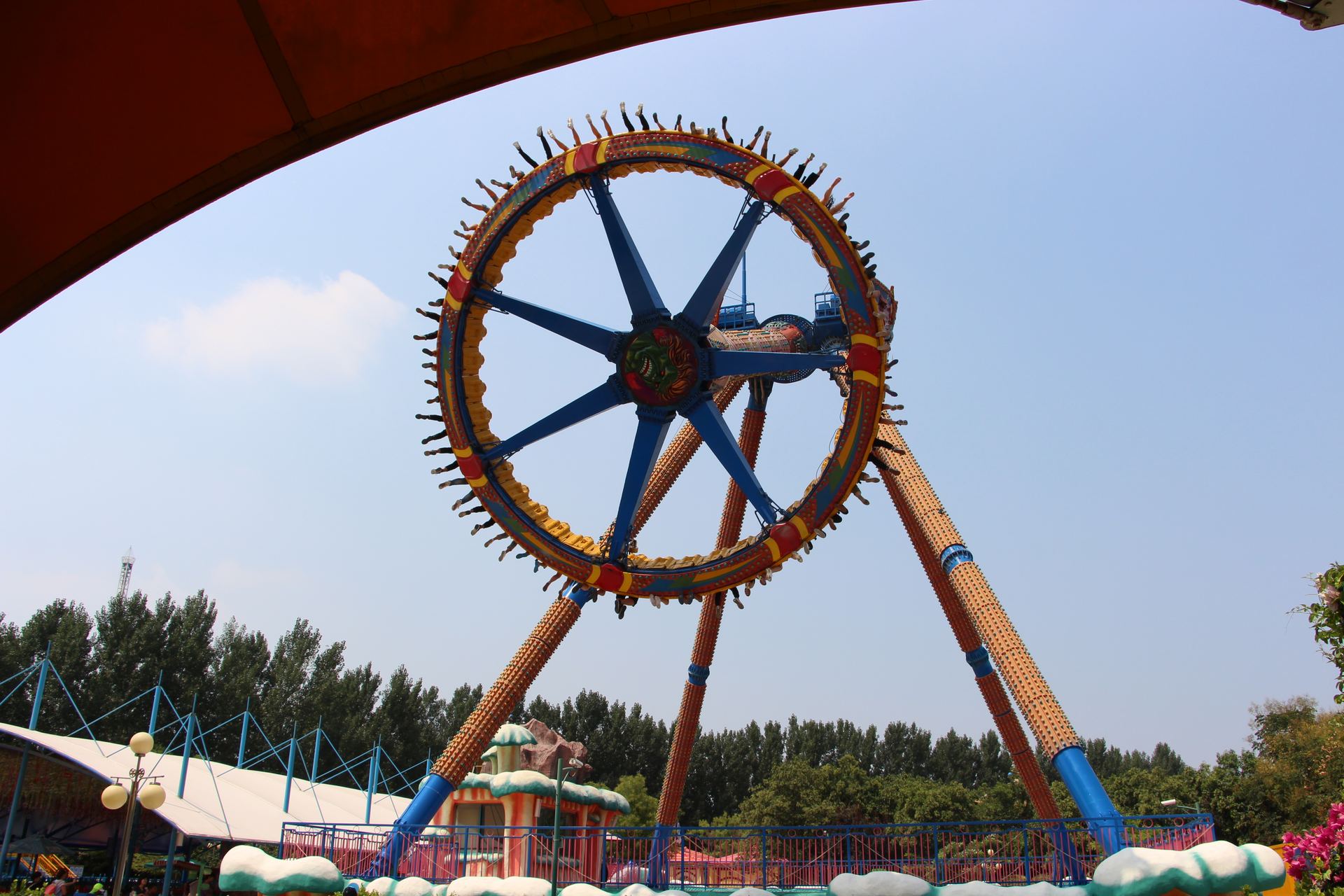
Ride street anchor
Place the pendulum at the far end of your main walkway so the swinging arm is visible from the entrance and draws visitors through the park.
The 30-seat pendulum is the workhorse of the range. It gives a full 120° swing and an 18 m operating height on a plot that most established parks already own, with a power demand that usually avoids a transformer upgrade.
| Parameter | Specification |
|---|---|
| Rated capacity | 30 passengers |
| Maximum swing angle | 120° |
| Operating height | ≈18 m |
| Installed drive power | 90 kW |
| Supply | 380 V / 220 V, 3-phase, 50 Hz |
| Footprint | 16 × 16 m |
| Cycle time | ≈180 s including loading |
| Throughput | ≈550–600 riders per hour |
| Design service life | 15 years |
| Braking | Dual independent systems with parking brake |
| Restraint | Over-the-shoulder bar, individual lock sensors |
| Control | PLC with VFD ramp, fault log, cycle counter |
Figures are for the standard configuration. Final values are confirmed on the drawing issued with your quotation.
Adding seats to a pendulum ride raises the structural load on the arm, axle and foundation — not linearly, but steeply. Thirty seats is the point where the throughput gain is still large (roughly 570 riders per hour against 450 on a 25-seat machine) while the structure, foundation volume and installed power remain within the reach of a mid-size park.
It also holds a practical advantage during loading. Thirty seats fill quickly with two attendants working the gate, so the ride can hold its nominal cycle time even during a rush. Larger gondolas need more attendants or the cycle time stretches and the queue grows.
Place the pendulum at the far end of your main walkway so the swinging arm is visible from the entrance and draws visitors through the park.
The arm and gondola lighting package turns the ride into a landmark after dark, which extends your premium-ticket window.
Allow a 30–40 minute queue length in the layout — pendulum rides are capacity-limited, and a well-designed queue keeps visitors in the park rather than in the entrance plaza.
Keep the swept envelope clear of food kiosks and photo points, and place seating outside the fence line for the people waiting.
Deposit received; structural, electrical and foundation drawings issued for approval.
Fabrication of structure, axle, drive and gondola; fibreglass work and painting.
Workshop assembly, weighted swing test and third-party inspection.
Disassembly, crating and loading with a documented packing plan.
20–40 days by sea to most destinations.
8–12 days on site, then commissioning and operator training.
We will send the ride envelope, foundation load schedule, power requirement and an itemised quotation for your site.
We reply within one working day, usually sooner. If it is urgent, call or message us on WhatsApp.


16 × 16 m covers the machine footprint, foundation and swept envelope. Add a queue line of 30–40 minutes' capacity, an exit route that does not cross the entry, and a 2 m clear maintenance strip. Plan for 20 × 20 m in total on a greenfield site.
Price is driven by seat count, swing angle, theming depth, restraint specification and the shipping route. Send your configuration and we will supply an itemised quotation covering the ride, control system, lighting, packing and installation supervision.
About 180 seconds from load to unload, of which roughly 90 seconds is the swinging cycle. That yields 550–600 riders per hour with two attendants loading.
No — the 42-seat machine is a different structure with a different foundation. If you expect attendance to grow substantially, plan the larger foundation now and buy the 30-seat ride, so a future upgrade only replaces the ride assembly, not the civil work.
Plot size, power supply and target riders per hour are enough for us to recommend a model and send a layout sketch.
We reply within one working day, usually sooner. If it is urgent, call or message us on WhatsApp.